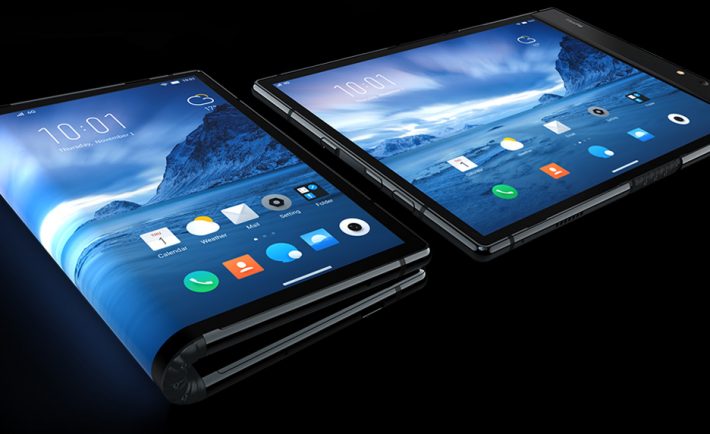
It came as a surprise to many when a barely known tech company introduced the world’s first foldable phone. The future of smartphone is upon us as Royole Corporation launched FlexPai in Beijing. Royale Corporation is a relatively new company, which was founded by Stanford engineering graduates in 2012. It will go down in history as the company who conquered the “foldable phone” race ahead from Samsung and Huawei.
For the digital savvy Singaporeans who are interested in acquiring their own FlexPai, here are its specifications. FlexPai boasts its “virtually unbreakable and extremely durable screen”, which can be bent for over 200,000 times. This smartphone can be folded like a paper or a wallet to display various small screens: in the front, back, and spine. While it is folded, you can receive incoming calls or take photos from front and back screens. The spine is where the notifications will show. Its 7.8-inch display resembles a tablet when fully unfolded.
You may be wondering if it can take some Instagrammable shots. To tell you frankly, it has two cameras with 20 and 16 megapixels. You can bend it to capture objects and subjects at unique angles. Other features include having a microSD slot, a fingerprint reader, a Snapdragon 8-series chip, and a USB-C port. Furthermore, it is running on an Android 9.0 based Water OS.
See this latest handset in action as you watch the following demo.
As with many first models, this pioneer handset is far from being perfect. Royole needs to address some glitches. For instance, it should offer a sleek design which does not have visible fold marks when straightened out. There should be seamless switch between front and back displays. Furthermore, it is a bulky device that is about 50% heavier than Note 9 and the iPhone XS Max.
Nonetheless, Royole’s foldable product encourages other tech companies to provide different experiences to the Millennial consumers. While consumers in China can purchase a consumer edition FlexPai today, global consumers can pre-order the developer version online. The 6 GB model with 128 GB storage is available to consumers for $1,588 (about S$2182), while the 8 GB model with 256 GB costs $1,759 (about S$2417). These devices are expected to be shipped by December.
With all these information in mind, I am excited to see the foldable products that well-known tech companies will launch soon (e.g., Samsung Galaxy F).
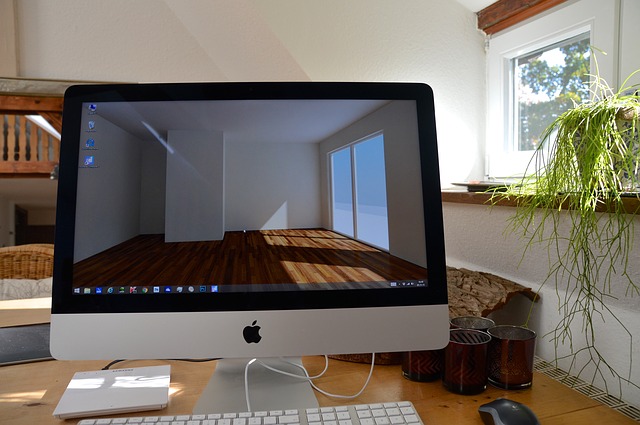
The average lifespan of a laptop is between two to four years. Due to the many mishaps that can happen throughout the course of time, it is not uncommon for a machine to last for less than a year.
If you are not on-board with the idea of shelling out thousands to replace your laptop then, you must take certain precautions to maximize its lifespan. May the following tips help your circumstance.
LET ME FREEZE YOU
Unbeknownst to many, overheating is among the top reasons why laptops fail. Snuggling up in your bed with your trusty laptop as you watch your favorite movies sounds divine! However, your lap is not the best place to use this machine. Any soft or uneven surfaces can block the vents and restrict the airflow. It is recommended to work on a hard and smooth surface or to use a laptop support.
ADD MORE RAM
Random-access memory or RAM stores data and machine code that is currently being used. It works like your short-term or working memory. You can rely more on the system that pulls the data afresh from the hard drive once you upgrade your RAM. You see, reducing your hard drive activity reduces the power consumption. Other performance benefits will be quickly seen upon adding more RAM.
KEEP IT CLEAN
It comes as no surprise that a clean laptop will last longer than a filthy one. Unless you are working in a highly sanitized room, every laptop can come in contact with dust and dirt on a daily basis. Left to linger long enough, these unfriendly substances can suffocate the hardware of your laptop. Doing so will reduce its performance or contribute to a component’s premature demise.
UPGRADE TO SSD
Bid farewell to moving parts by switching to an SSD and using flash data memory to store your data. If possible, this upgrade will immediately make your laptop more energy efficient. Aside from its benefits surrounding your laptop’s battery life, an SSD can deliver a faster performance. Furthermore, it removes problems associated with fragmentation.
UPDATE YOUR SYSTEM REGULARLY
Whether you are a computer geek or not, it takes a few clicks of the mouse to update your operating software. Do not hesitate to update your current system once a notification comes up! Remember that no operating system or program is perfect. Hence, every upgrade includes new features and solutions to previous issues.
Aside from patching up some issues, keeping your software updated reduces the chances of security exploits. Maximize your security by regularly running anti-virus and anti-malware scanners. Less malware and junk supports a smooth running system.
SHIELD THE OUTSIDE
Modern technology has led to the introduction of smaller, thinner, and lighter laptops. This means that these machines are more susceptible to damage from spills and drops. Extend the life of your device by providing laptop covers and screen protectors. A tumble off your desk or a scratch against the wall can be shielded thru a powerful hard-shell or soft-shell case. Just ensure that your protection does not obstruct the laptop’s cooling system.
SIMPLIFY YOUR LIFE
Multitasking is a necessity in today’s revolving world. It may sounds nice, but running several programs at once puts a significant load on the processor. This further creates more power consumption. So, stretch your battery’s life and take care of your laptop by simplifying your activities.
As much as possible, stick to one application at a time. Close any additional programs when typing a document. For instance, I only use Notepad when writing a draft for my articles. How about for listening to music? Instead of streaming some tunes, you can use the locally stored songs. Streaming media over Wi-Fi uses the laptop’s wireless radio and other components. Less is more.
Despite how devoted you are to Apple and its products, your beloved company has its flaws. It is far from perfect! Even the most luxurious iPhone of all time has its decent share of criticism from its first buyers. Thus, this list will shed a light to its darkest paths.
1980: APPLE III
Imagine being instructed to lift and drop your computer about 6 inches to reset the chips that are coming out of the circuit board. It sounds ridiculous to perform this task at a time where Genius Bars exist. However, Apple III users were madly disappointed in the 80’s. You see, Apple III was plagued with hardware issues including faulty circuit boards and heating issues. The company had to recall every existing machine on the market (about 14,000 units). Then, the machine was re-marketed with new parts a year later.
1983: THE LISA
Every possible list of Apple flops will include “The Lisa”. Released in 1983, the Apple Lisa was known for being the first commercial computer to be sold with a graphical user interface and a mouse. The main drawback of this machine is its insane price-tag of US$9,995 (about S$13,700).
The steep price proved to be unreachable for many customers! It only sold 100,000 units before the model was discontinued. Furthermore, Apple released one of its most iconic products in 1984. This product is none other than the first Macintosh computer.
1993: MACINTOSH TV
The Macintosh TV was a failed product attempt that launched in 1993. On paper, combining a computer hardware with the experience of watching a television sounds like a great idea. However, they were not able to execute it well.
The Macintosh TV resembled a Macintosh LC 500 series computer with a TV tuner card. Users were able to hook it up to a cable line or an antenna. The major problem is: you cannot use the television while using the computer. As expected, Apple only sold 10,000 Macintosh TVs. The product was discontinued in three months time.
1993: NEWTON MESSAGEPAD
When your product gets mocked by a cartoon as popular as The Simpsons, you will realize what type of impact you evoke on your users. Take Apple’s Newton MessagePad as an example. The company’s take on the PDA was innovative, but it was pretty expensive. It retailed for S$700 (S$960) in 1993. Moreover, its handwriting recognition feature rarely works!
Image Credits: pixabay.com
When Steve Jobs returned in the late 90’s, he focused much of his energy on phones and tablets. You will see this pan out throughout the years.
Since April this year, households in Jurong have been able to choose who they wish to buy electricity from, thanks to the soft launch of Open Electricity Market by the Energy Market Authority. One early adopter who exercised his choice to switch to an electricity retailer is Mr Luqman Haniff, a 30-year old with seven family members staying with him. We share about his journey here.
1. Household Electricity Consumption
One of the first things to look at before switching to a retailer is to find out more about your past electricity usage. That was exactly how Mr Haniff started off his Open Electricity Market journey. By looking through his past electricity bills, he was able to estimate how much his electricity bill would come up to if he were to pay by the regulated tariff or by the rate offered by electricity retailers. This helped him to choose a price plan that best suit his household’s needs.
What is the regulated tariff?
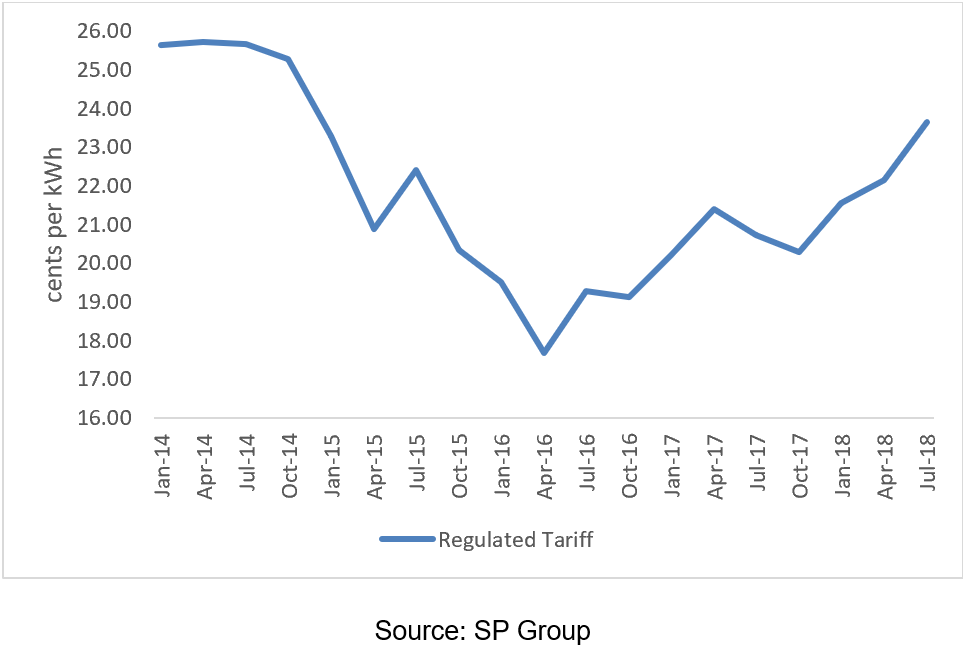
Let us take a look at how the regulated tariff is derived. The regulated tariff is reviewed every quarter by SP Group and approved by the Energy Market Authority (EMA). It consists of two key components – fuel cost and non-fuel cost. Fuel cost reflects the cost of imported natural gas while the non-fuel cost reflects the cost of generating and delivering electricity to homes. Below is a snapshot of the historical tariff rates.
Electricity retailers’ standard price plans
On the other hand, electricity retailers are free to customise their price plans according to their business strategies, current market conditions and the level of competition in the market. That said, the two main types of standard price plans are:
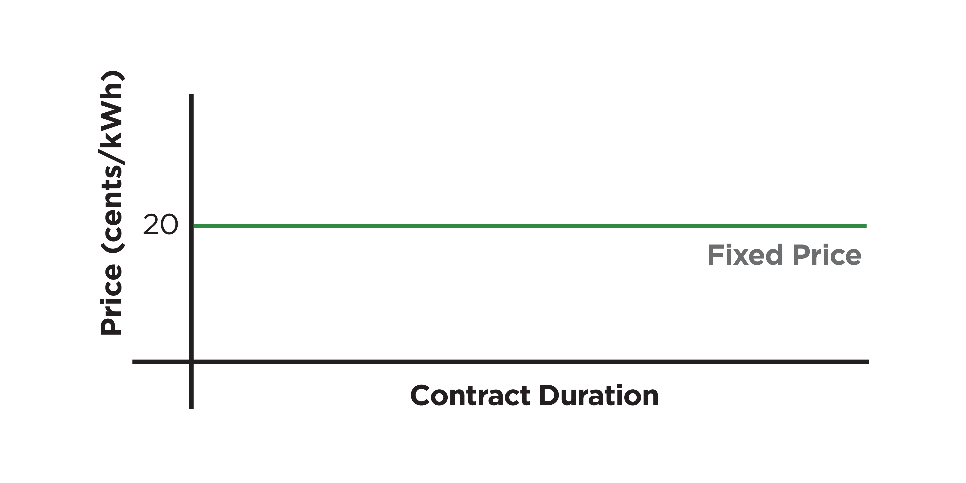
Fixed Price Plan– You pay a fixed rate throughout the duration of the contract. This rate may be higher or lower than the regulated tariff.
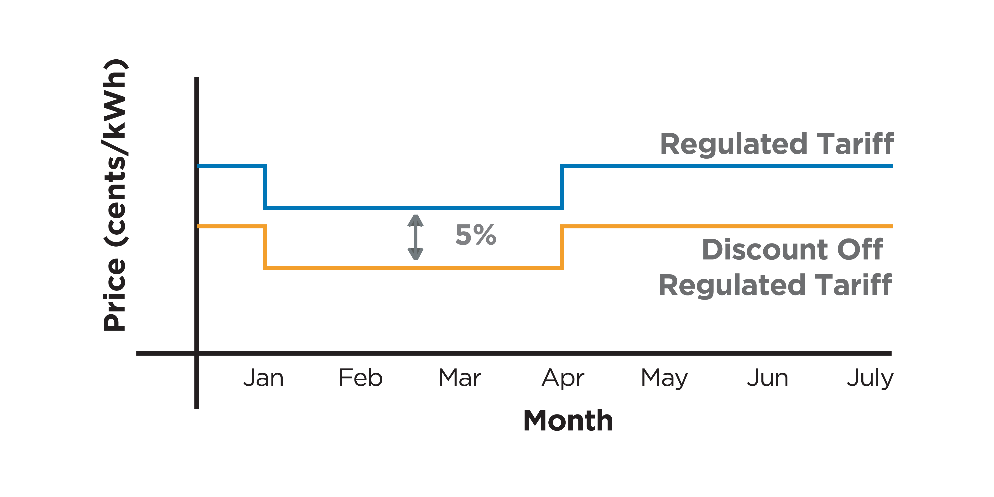
Discount Off the Regulated Tariff Plan – You enjoy a discount off the regulated tariff throughout the duration of the contract.The rate may change every quarter in tandem with the prevailing regulated tariff.
Besides visiting the retailers’ websites to check on their offers, Mr Haniff made use of the Price Comparison Tool on the Open Electricity Market website to compare the different standard price plans offered by retailers. Like him, you can make use of this tool to help you decide on the plan that would be most suitable for you.
2. Consumer Needs
Different households use electricity differently and may also have different ways of managing their electricity expenses. For instance, a family who prefers to keep their electricity bills as stable as possible may find the Fixed Price Plan more suited for them since they could better manage their overall household expenses.
On the other hand, another family may consider going with the Discount Off the Regulated Tariff Plan if they prefer the certainty of enjoying savings no matter how the regulated tariff changes.
Before Making the Switch…
Now that you are almost on your way to signing up with a retailer, do take note of the following as well:
Fact Sheet
Before you sign up for a plan, your electricity retailer will provide a Fact Sheet which summarises key contractual terms of your preferred price plan such as:
Contract duration
Type of price plan
Rate offered by the electricity retailer
Payment terms
Early termination charges, if any
Ask the retailer to explain any terms and conditions that you are unsure of.
Consumer Advisory
Electricity retailers will also need to obtain your acknowledgement on a Consumer Advisory notice which outlines what you need to be aware of before signing the contract.
Promotions and freebies
To draw more customers, electricity retailers may offer freebies such as vouchers and cash rebates. While they may entice you to sign up with them, one thing to remember is that these freebies are usually a once-off benefit. Hence, it is always better to think long-term and make sure you stand to benefit from switching to a retailer in the longer run.
From the get-go, there seems to be a wide range of standard price plans offered by electricity retailers. However, upon closer examination, the plans mainly differ in terms of contract duration and rates and come with different sets of terms and conditions.
As you review your choices, find out about your electricity consumption patterns, compare the different standard price plans by using our check-list and finally, be sure to take note of the things to consider before making the switch. You will be well on your way to benefit from Open Electricity Market, just like how Mr Haniff did!
Currently, residential consumers (like you and I) can buy electricity only from SP Group. This will gradually change as the Energy Market Authority (EMA) sets its sights on further opening up of the electricity market. This will allow households to buy electricity from a retailer at a price plan that best meets their needs.
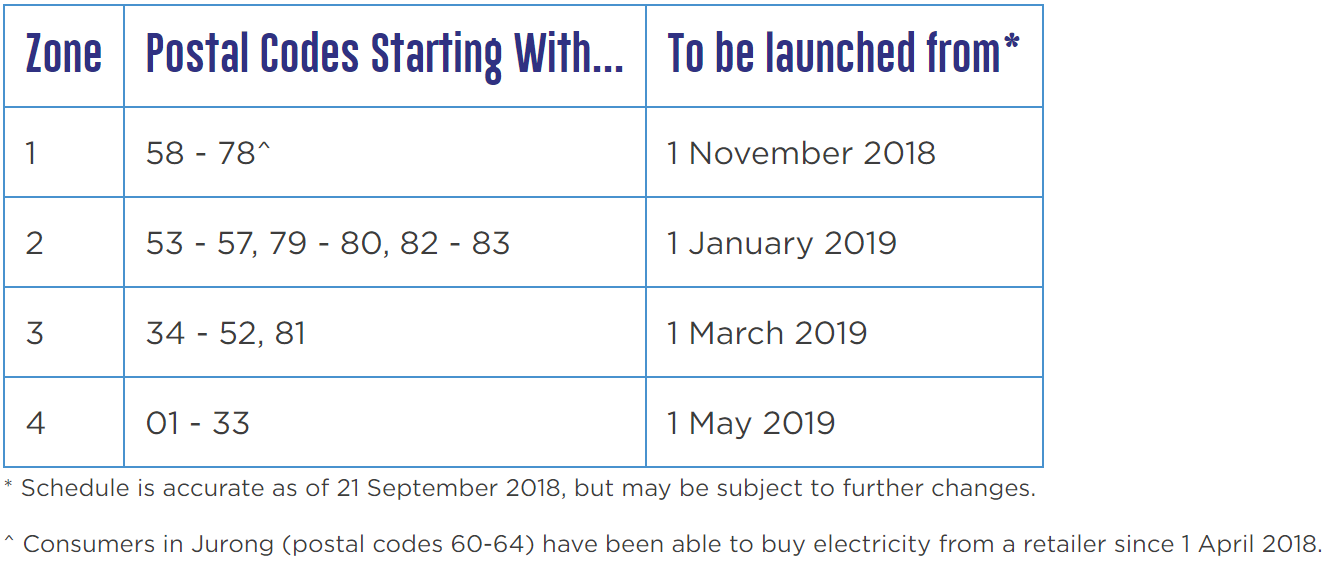
Since the soft launch of the Open Electricity Market (OEM) in April 2018, those staying in Jurong enjoy more choices and flexibility when it comes to buying electricity, thanks to more competitive pricing and innovative offers. It will roll out progressively in four geographical zones starting from 1 November 2018.
With different price plans available, choosing one that best suits your needs may come across as daunting. We are here to help you make an informed decision. This is no different from selecting a mobile phone plan from telcos where users are encouraged to pick a plan that best suit their needs.
What are the types of standard price plans?
First, let us take a look at the standard price plans available. At present, there are a total of 13 retailers offering over 60 standard price plans for residential consumers. These fall under one of the following 2 types:
Fixed Price – Consumer pays a fixed rate throughout the duration of the contract.
Discount Off the Regulated Tariff – Consumer enjoys a fixed discount off the regulated tariff throughout the duration of the contract.
How to go about choosing a price plan?
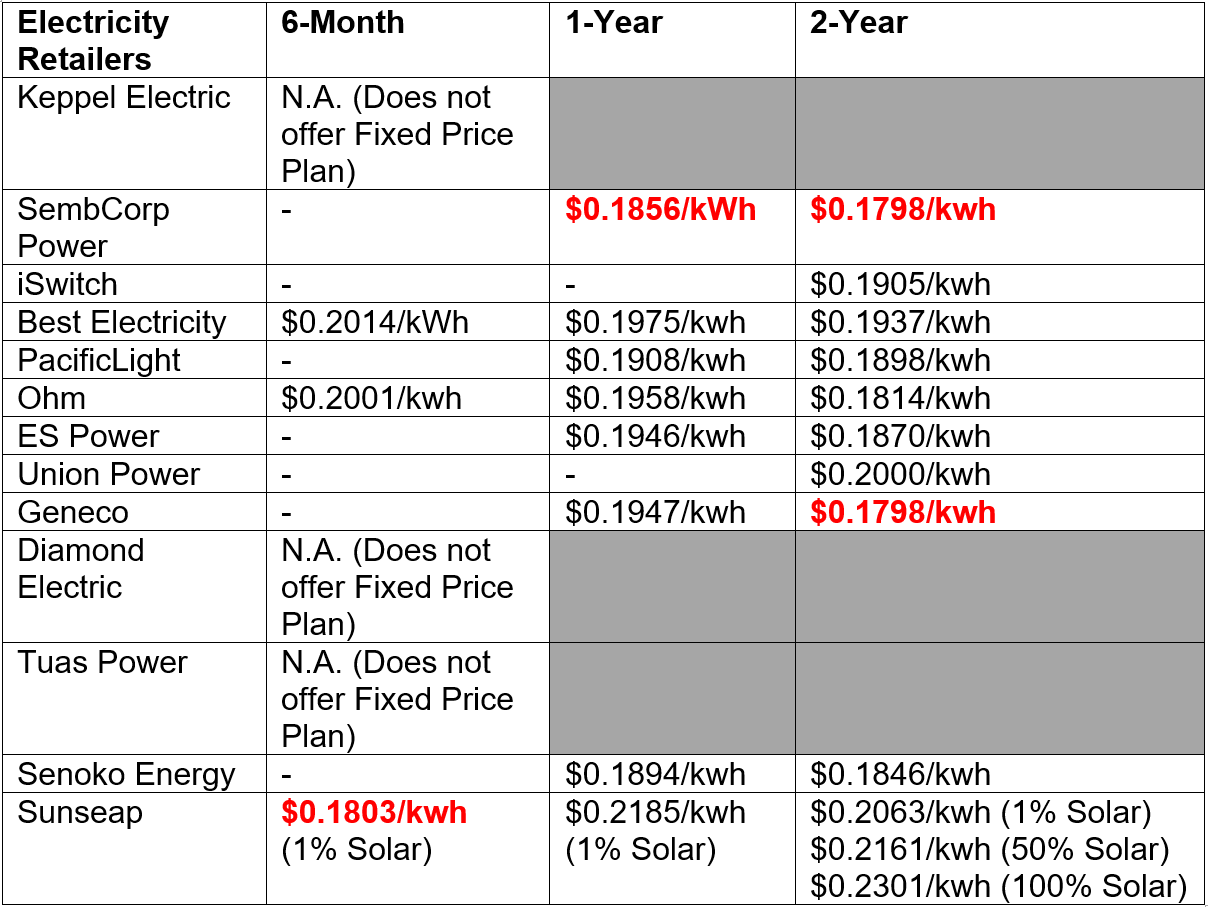
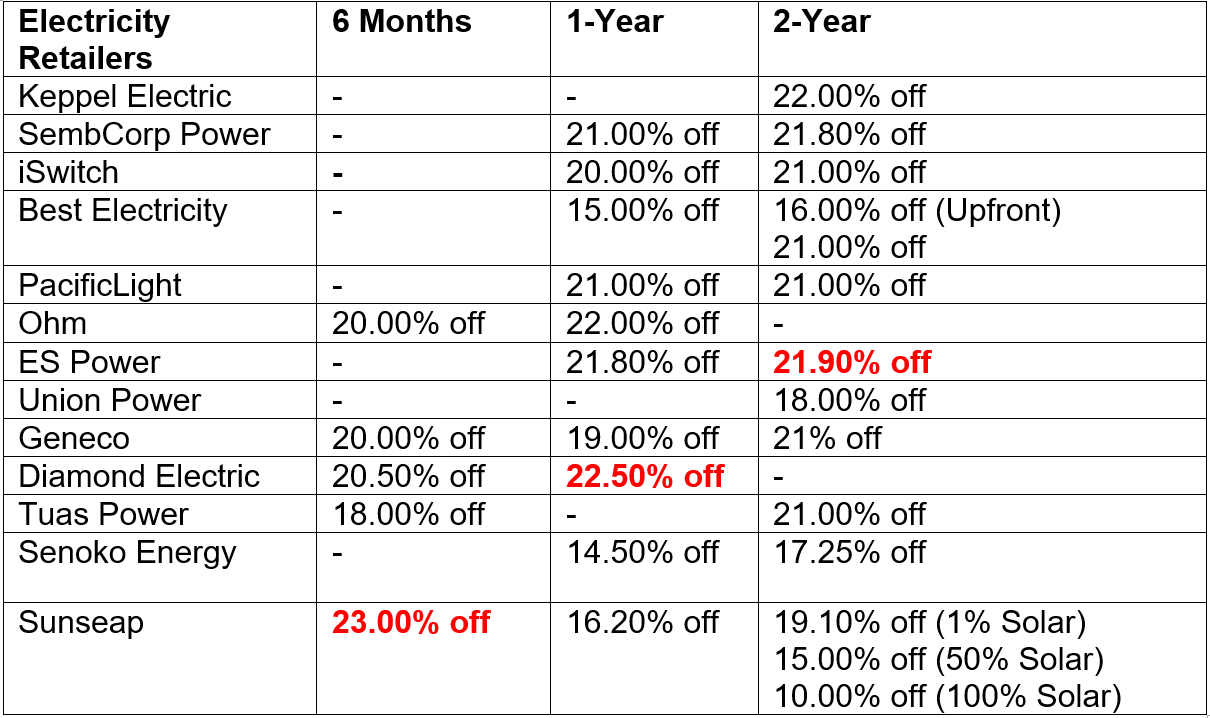
Now that you are aware of the types of standard price plans available, what should you keep in mind when choosing a plan? Here is a comparison of the 2 standard price plans offered by 13 electricity retailers.
Plans stated are accurate as of 8 November 2018 and are subject to change. For the latest price plans, please visit www.openelectricitymarket.sg or the retailers’ websites directly.
A. Fixed Price Plan
If you opt for a Fixed Price Plan, you will pay a constant rate per kilowatt hour for your electricity during the contract period.
The advantage of this price plan is that you are assured of the same rate every month throughout your contract with your retailer, i.e. more price certainty. Do note that the rate the retailer offers may be higher or lower than the regulated tariff which is reviewed every quarter.
As of 8 November 2018, Sunseap offers the best rate for 6-month contract, while SembCorp Power has the best rate for 1-year contract and both SembCorp Power and Geneco offers the best rate for 2-year contract.
B. Discount Off The Regulated Tariff Plan
If you are someone who does not want to think too much about price movements and wishes to pay less than the regulated tariff, a Discount Off the Regulated Tariff Plan may be the plan for you. Here, the rate will always be based on a fixed discount off the regulated tariff. The catch is, unlike the Fixed Price Plan, the rate may change each quarter during the contract duration.
As of 8 November 2018, Sunseap offers the best rate for 6-month contract, while Diamond Electric has the best 1-year contract and ES Power has the best rate for 2-year contract for a Discount Off the Regulated Tariff Price Plan.
As with making any comparisons for the best deal, it is important to read the fine print. Before you select a price plan, do consider these key areas:
The contract duration that you are willing to be locked in;
The amount of security deposit needed;
Whether there are any early contract termination charges and if so, how much;
The billing and payment arrangement offered by the retailers; and
Whether there are any bundled services or products or other additional perks offered, and to be aware of the terms and conditions associated with these perks.
The rates stated in the standard price plans should be inclusive of all charges for electricity consumption such as Transmission Loss Factor (a fee to account for network and transformer losses in the course of delivering electricity to consumers).
What else you should know when choosing a standard price plan?
While you may enjoy savings as a result of buying from a retailer, the amount you save could vary based on when you use electricity and how much electricity you eventually use. Of course, the type of standard price plan you choose plays a role as well.
Even after switching to a retailer, you can always switch back to buying electricity from SP Group at the regulated tariff. However, you might want to take note of any early termination charges levied by your retailer.
Finally, if you have any dispute with your electricity retailer (we hope not), you can always approach the Consumer Association of Singapore (CASE) for advice and assistance.
Note: This article has been updated on 8 November 2018 to reflect the 2 standard price plans (instead of 3) with the latest pricing, and the inclusion of 2 new added retailers ES Power and Union Power.